
Scalp Exosome vs PRP vs GFC: Best Hair Loss Treatment
KorinMi Clinic
You may have experimented with different shampoos, used hair growth serums, and followed all possible advice for hair care. Yet it does not seem to help you, as the hair strands continue to fall and the parting line gets wider.
You may have experimented with different shampoos, used hair growth serums, and followed all possible advice for hair care, but it does not seem to help you, as the hair strands continue to fall and the parting line gets wider.
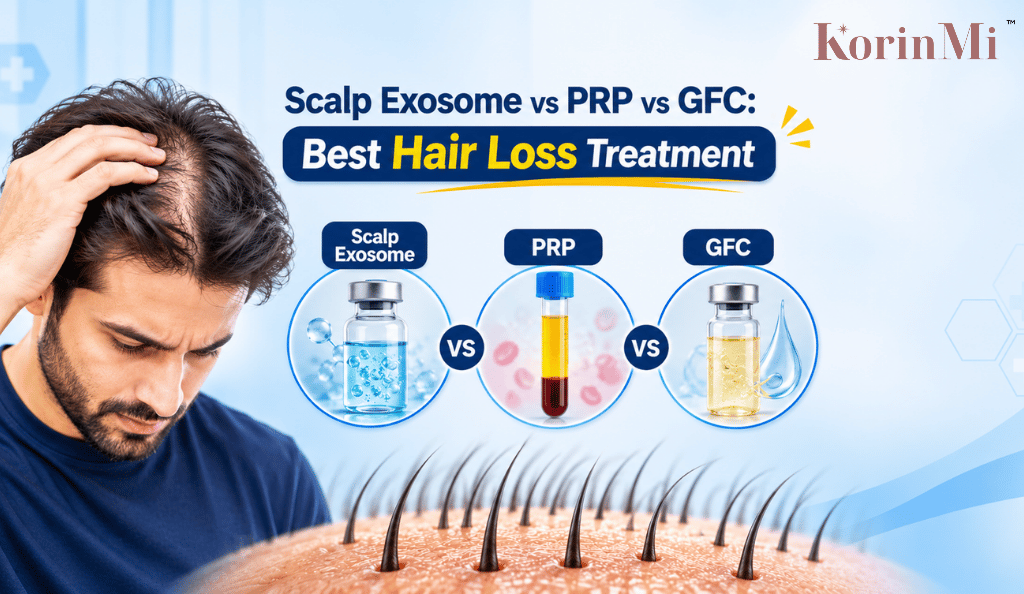
All three of these treatments support hair growth, but they work differently.
So, let’s compare scalp exosome vs PRP vs GFC for hair loss to decide which approach may suit your hair concerns.
Understanding the Three Hair Regrowth Treatments
Before comparing their effectiveness, it helps to understand what actually goes into each treatment.
-
Scalp Exosome Therapy
Exosomes are small vesicles used by cells to communicate with each other. These vesicles transport signals, which include biological compounds like proteins and lipids that affect cellular function.
Researchers are currently studying exosome preparations for hair restoration because they can enhance follicular function and cellular communication. We have a detailed guide on scalp exosome treatment for hair growth. -
PRP (Platelet-Rich Plasma) Therapy
PRP is an established regenerative treatment that uses a component of your own blood. During the procedure, a small blood sample is collected and processed in a centrifuge to separate platelet-rich plasma. This concentrated portion contains platelets that release growth factors involved in tissue repair and cellular signalling. The prepared PRP is then injected into selected areas of the scalp.
-
GFC Treatment for Hair Fall
GFC is another blood-derived regenerative treatment designed to deliver concentrated growth factors to the scalp.
Like PRP, it begins with collecting a small sample of the patient's blood. However, the preparation process differs. It uses a specialised processing method to obtain a growth factor-rich concentrate for scalp administration.
GFC vs PRP vs Exosome Treatment: Key Differences at a Glance
Although these treatments share a common goal, their biological approaches differ.
|
Comparison |
Exosome Therapy |
PRP Therapy |
GFC Therapy |
|
Source |
Depends on the exosome formulation |
Patient's own blood |
Patient's own blood |
|
Main components |
Extracellular vesicles and their signalling molecules |
Platelets and associated growth factors |
Concentrated growth factor-rich preparation |
|
Primary approach |
Cellular communication and regenerative signalling |
Platelet-mediated growth factor release |
Growth factor delivery |
|
Preparation |
Depends on product source and manufacturing |
Blood separation through centrifugation |
Specialised blood processing |
|
Clinical evidence |
Emerging and limited |
More extensive, but variable |
Growing but comparatively limited |
|
Treatment type |
Non-surgical, minimally invasive delivery |
Non-surgical injections |
Non-surgical injections |
Note: PRP and GFC use biological components obtained from the patient's blood, whereas exosome therapy uses extracellular vesicles from a separately prepared formulation. They are not interchangeable treatments, and their effectiveness cannot be judged by their marketing claims alone.
Which Hair Treatment Is Best for Hair Fall
The best hair fall treatment depends on why your hair is falling, how advanced the thinning has become and whether your hair follicles are still active. There is no single procedure that works equally well for everyone.
For people experiencing early-stage pattern hair loss, PRP may be worth considering because it has a relatively stronger clinical research base. GFC is another option that delivers concentrated growth factors to support follicular activity. Exosome therapy, meanwhile, is an emerging regenerative approach that may offer potential benefits, although more robust clinical research is needed to establish its effectiveness and long-term safety.
If hair loss is linked to nutritional deficiencies, hormonal changes, thyroid disorders or scalp inflammation, addressing the underlying cause should take priority over regenerative procedures.
Ultimately, the best treatment is not necessarily the newest or most expensive one. It is the one that matches your diagnosis, follicular health and long-term hair restoration goals.
Combination Hair Loss Treatment PRP GFC Exosomes
Combining treatments has interesting possibilities. However, combining multiple regenerative treatments does not automatically make the outcome more effective.
Each treatment works through a different biological approach. PRP delivers platelet-associated growth factors, GFC provides a concentrated growth factor preparation, and exosome-based formulations introduce extracellular vesicles involved in cellular communication.
Each treatment works through a different biological approach. PRP delivers platelet-associated growth factors, GFC provides a concentrated growth factor preparation, and exosome-based formulations introduce extracellular vesicles involved in cellular communication.
That’s why consulting with experts matters the most.
Try the Best Hair Regrowth Treatment for Thinning Hair
Thinning hair does not always mean permanent hair loss. When identified early, the right treatment approach may help support existing follicles, improve hair density and manage progressive hair thinning.
Whether you are considering PRP, GFC or Korean scalp exosome therapy, the first step is understanding what your scalp actually needs. Choosing a treatment based on its popularity or latest trends may not deliver the results you expect.
At KorinMi, we offer personalised Korean hair and scalp care solutions designed around individual concerns. If you are experiencing persistent hair fall, reduced hair density or visible scalp thinning, our team can help you explore suitable treatment options based on your needs.
Ready to take the next step towards healthier-looking, fuller hair?
Book your consultation today!
Frequently Asked Questions (FAQs)
What is the difference between scalp exosome, PRP, and GFC treatment?
Scalp exosome therapy uses extracellular vesicles involved in cellular communication, while PRP uses platelet-rich plasma from the patient's blood. GFC uses a specialised process to prepare a concentrated growth factor-rich solution. All three aim to support hair follicle activity through different biological approaches.
Which is better for hair fall: exosome, PRP, or GFC?
There is no universally best option. PRP has a more established clinical evidence base, while GFC and exosome therapy are emerging alternatives with promising but comparatively limited research. The right choice depends on the cause and stage of hair loss.
How does Korean scalp exosome treatment work for hair growth?
Korean scalp exosome treatment involves delivering an exosome-containing formulation to targeted scalp areas, depending on the treatment protocol. These extracellular vesicles carry biological signals that may influence cellular communication and follicular activity. However, clinical evidence supporting their effectiveness for hair regrowth is still developing.
Who is a good candidate for scalp exosome treatment?
People experiencing early-stage hair thinning or pattern hair loss with potentially active hair follicles may be considered for exosome-based treatment. A dermatologist should assess the cause of hair loss, scalp condition and suitability of the specific formulation before recommending it.
Can exosome treatment be combined with PRP or GFC?
Combining exosome therapy with PRP or GFC may be considered in selected cases, but there is insufficient high-quality evidence to establish that the combination produces better results. A dermatologist should determine whether combining procedures has a clear clinical benefit for the individual.
How many sessions are needed for visible hair regrowth?
The number of sessions varies depending on the treatment protocol, extent of hair loss and individual response. PRP and GFC commonly involve multiple sessions, while exosome treatment schedules depend on the formulation used. A personalised treatment plan is essential.
How soon will I see results after exosome or GFC treatment?
Hair regrowth is gradual and varies between individuals. Some clinical studies assess early changes within 2-3 months, but meaningful improvements in hair density may take longer. Results depend on follicular health, the underlying cause of hair loss and treatment response.
Is scalp exosome treatment safe, and what are the side effects?
The long-term safety of scalp exosome treatment has not yet been established through sufficient large-scale clinical trials. Potential short-term effects include scalp redness, itching, swelling and injection-site discomfort. Product quality, biological source and clinical administration should be carefully evaluated before treatment.
What is the cost of exosome, PRP, and GFC hair treatment in Gurgaon?
The cost varies depending on the treatment formulation, preparation method, number of sessions, scalp coverage and clinic protocols. Exosome therapy may have different pricing from PRP and GFC due to product sourcing and processing requirements. A consultation is recommended for an accurate treatment estimate.
When should I choose a Korean scalp exosome program instead of PRP?
A Korean scalp exosome program may be worth discussing if you are exploring emerging regenerative approaches to hair restoration. However, PRP currently has a stronger clinical evidence base for pattern hair loss. Your dermatologist should compare the available evidence, product quality, suitability and expected outcomes before recommending either option.
Related Post

Laser Hair Reduction Treatment Cost in India: Real Pricing Guide
Admin
You shave, wax, or thread…and a few days later, it is back again!
read more
Is Hair Spa Treatment Good for Hair Fall?
Admin
Winter is ahead, and you might find a few strands on your pillow, comb, in the bathroom drain, and basically everywhere.
read more
What Is Alopecia and What Treatment Options Are Available Today?
Admin
Alopecia areata is an uncommon hair loss condition with no major symptoms. It is like a bald patch on the head where you see sudden hair loss.
read more